
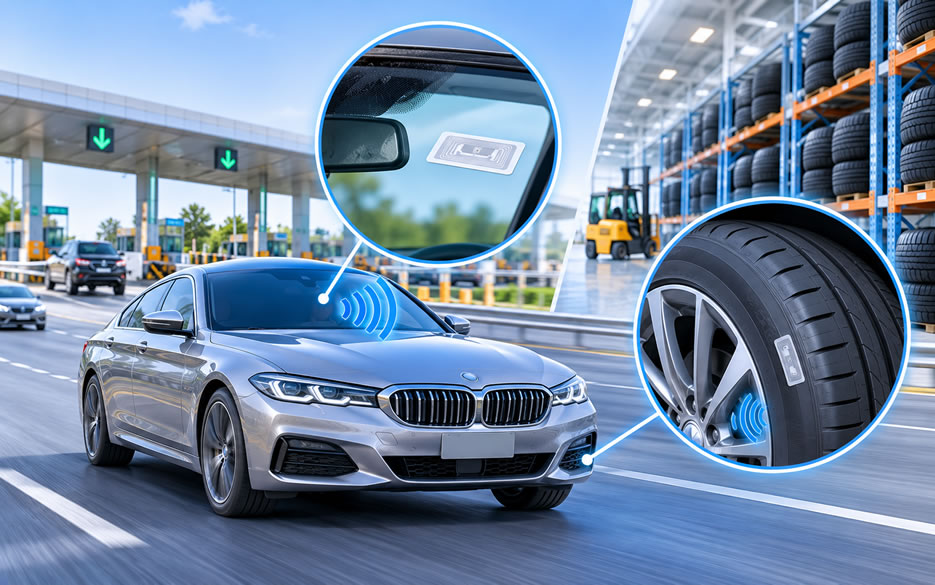
RFID technology identifies moving vehicles accurately in real time, supporting traffic information collection and vehicle access control. Windshield labels adhere to the inner surface near the mirror or housing gap, resist infrared and ultraviolet light, and can be read from up to about 10 meters for access lanes, tolling and parking. tire RFID tags are embedded inside the tire during production, storing tire serial number, production date and factory code for traceability and inventory management.
Why automotive needs RFID
Vehicle access, parking and highway tolling require fast identification without stopping. Manual ticket issuing or barcode scanning is limited by distance, angle and speed, and queues build up during peak hours.
Tires are critical components that need to be linked to production batches, serial numbers and factory information. Conventional markings wear off or fall away, making batch-level traceability difficult. RFID labels give vehicles and tires unique identities so that access records and product flows can be captured automatically.
Windshield tags and tire tags in practice
The two label types serve different objects and workflows, but both rely on non-contact identification.
- Windshield tag placement: apply near the rear-view mirror or in the gap around the housing, with a waterproof printable film on the face.
- Vehicle reading: readers capture tags at distance for vehicle access, contactless tolling, parking entry and gate control, reducing stops and waiting.
- Tire tag embedding: insert the RFID tag inside the tire during production and write the serial number, production date and factory code to the chip.
- Tire traceability and inventory: read tags at goods receipt, warehousing and delivery to verify model and quantity, and trace a batch when quality issues arise.
- Data integration: link access records and tire profiles with management systems for fleet control, reporting and regulatory checks.
Tag selection and application tips
- Windshields: UHF labels resistant to infrared and ultraviolet with a waterproof printable face; confirm how placement affects reading.
- Laminated or special glass: dedicated inlay constructions can be evaluated, with the bonding process confirmed by the glass manufacturer or installer.
- In-tire tagging: tags must meet tire production and durability requirements. This is project-based customization and cannot be replaced by ordinary adhesive labels.
- Visual verification: add barcode, QR code, plate number or serial number for both automatic and manual checks.
Read range depends on reader power, antenna, placement and surrounding metal. Test with real vehicles and on-site equipment before finalizing specifications.
Practical benefits
- Contactless identification at gates and toll lanes reduces queues and improves traffic flow.
- Weather-resistant, printable labels support long-term use and visual verification.
- Automatic capture of tire serial number, production date and factory code reduces manual entry errors.
- Trace tires across production, warehousing and delivery for faster issue tracking and targeted recall.
Recommended RFID Labels
- UHF Windshield Labels (long-range, print-ready, waterproof film)
- Windshield Inlays for laminated glass applications
- Tire RFID Tags for in-tire embedding (project-based evaluation)
- UHF Adhesive Labels for vehicle and part identification
Key Advantages
- Long read range up to about 10 meters for moving vehicles
- Resistant to infrared and ultraviolet light for windshield use
- Waterproof printable surface supports variable data and visual checks
- In-tire tags store unique ID, production date and factory code
- Suitable for access control, tolling, parking and tire traceability
Typical Use Cases
Vehicle access control, barrier-free passages, highway tolling, parking lot entry and exit, fleet and gate management, tire manufacturing traceability, tire inventory and supply chain