
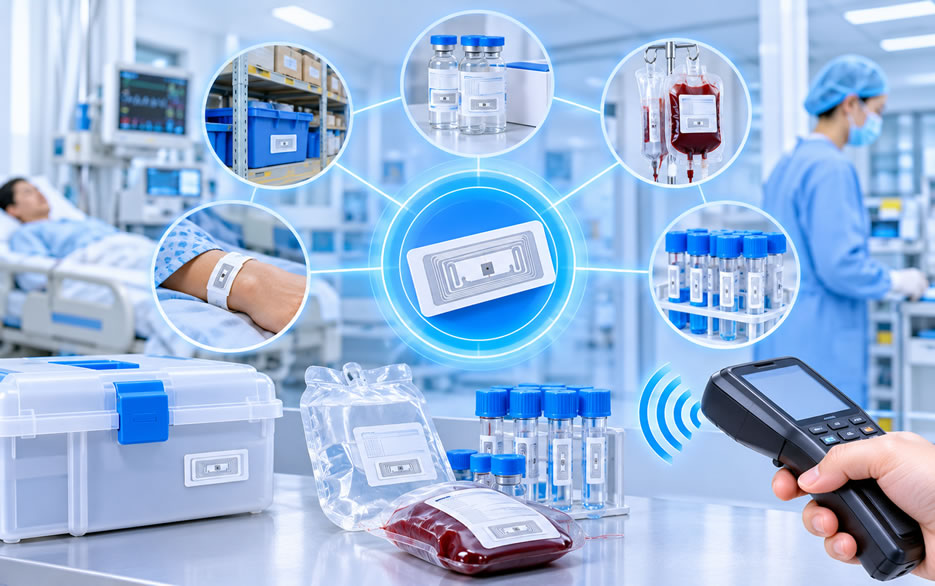
RFID labels are used in hospitals and healthcare logistics to identify high-value consumables, medicines, blood bags, patient wristbands and laboratory sample tubes. Item-level IDs support receiving, storage, distribution and usage tracking. For temperature-sensitive vaccines, blood products and biological samples, label solutions can be evaluated together with temperature-monitoring devices for cold-chain storage and transport.
Why smart healthcare needs RFID
Hospitals handle large volumes of high-value consumables, medicines, blood products and lab samples. Manual logs and one-by-one barcode scanning often lead to delayed records, stock discrepancies and incomplete batch traceability.
Vaccines, serum and biological samples are highly temperature-sensitive. A single excursion outside the required range can affect effectiveness. RFID and NFC labels give each item a unique identity; linked to hospital systems, they leave queryable records across purchasing, storage, distribution, use and disposal.
From procurement to clinical use
The workflow starts with item-level tagging, linking suppliers, hospital warehouses, departments and patients or samples. Every operation is tied to a specific item and timestamp.
- Register and tag: attach a label to consumables, medicines or sample containers, write a unique ID and link product name, batch, expiry date and supplier.
- Goods receipt: read tags in batches and reconcile against purchase orders, recording batch and expiry automatically.
- Storage and cold chain: keep location and stock status updated; pair temperature logger devices where required, and select label materials suitable for the actual temperature conditions.
- Department issue and delivery: read tags at handover to identify the custodian and usage time.
- Clinical use and billing: scan the tag when a consumable is used and link it to the patient or wristband to avoid missed or incorrect records.
- Wristbands and samples: bind unique IDs to patient wristbands, lab tubes and blood bags to reduce mix-ups.
- Cycle counting and expiry alerts: run batch counts and receive reminders when stock is low or items approach expiry.
Tag selection and application tips
- Patient wristbands and lab tubes: NFC / HF or small UHF labels, with comfort and water resistance confirmed on site.
- High-value consumables and medicine boxes: UHF adhesive labels for batch reading and batch / expiry management.
- Metal cabinets or refrigerated equipment: watch for metal and liquid effects; use anti-metal labels or adjust placement if needed.
- Cold-chain and ultra-low temperature: temperature sensing usually needs dedicated devices; we can evaluate label constructions and attachment methods, with temperature tolerance confirmed by sample testing.
- Visual checks: add barcode, QR code, batch number and expiry date for both automatic and manual verification.
Healthcare environments demand high standards of safety, hygiene and reliability. We recommend a small pilot to verify reading, attachment and cleaning or disinfection procedures before volume rollout.
Practical benefits
- Trace batches, expiry dates and flow of high-value consumables and medicines to reduce stock discrepancies.
- Move from one-by-one scanning to batch reading at receipt, issue and inventory counts.
- Bind unique IDs to wristbands, tubes and blood bags to reduce sample mix-ups.
- Pair with temperature records in cold-chain and ultra-low-temperature scenarios to catch excursions early.
- Link usage records with billing to reduce missing entries and reconciliation disputes.
Recommended RFID Labels
- NFC / HF Adhesive Labels for wristbands and sample tubes
- UHF Adhesive Labels for high-value consumables and medicines
- Custom RFID Labels for cold-chain projects (evaluated per requirement)
- Printable Labels with Barcode, QR Code, batch and expiry data
Key Advantages
- Unique item ID for traceable consumables, medicines and batches
- Batch reading of wristbands, tubes and supplies instead of one-by-one scanning
- Optional printing of barcode, QR code, batch and expiry date for visual checks
- Label options can be evaluated for cold-chain and ultra-low-temperature environments
- Works with handheld readers and fixed readers for different hospital workflows
Typical Use Cases
Hospital high-value consumable cabinets, pharmaceutical and vaccine warehousing, blood bags and biological samples, patient wristbands, laboratory tube sorting, cold-chain transport and ultra-low-temperature storage